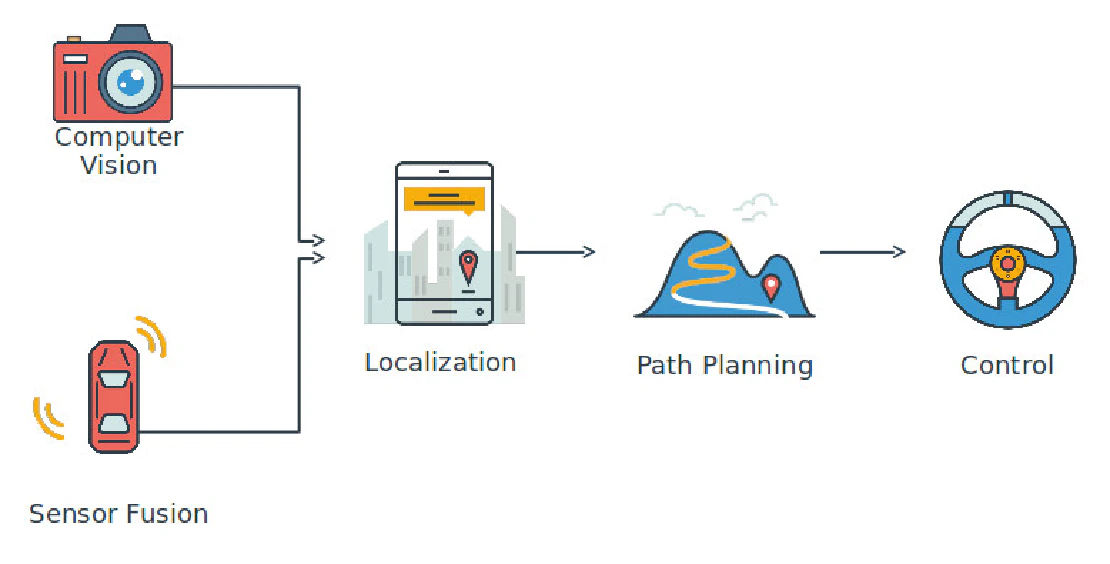
Computer Vision vs. Sensor Fusion: Who Wins the Self-Driving Car Race?


Tesla’s bold claim that “humans drive with eyes and a brain, so our cars will too” sparked one of the most polarizing debates in autonomous vehicle (AV) technology: Can vision-only systems truly compete with—or even outperform—multi-sensor fusion architectures?
At the core of this debate lies a fundamental design choice in how self-driving cars perceive and interpret their environment. Do you rely solely on high-resolution cameras feeding convolutional neural networks (CNNs), or do you incorporate data from LiDARs, radars, ultrasonic sensors, GPS, and IMUs into a probabilistic fusion framework?
Tesla Bet on Vision Alone—But Is That Enough?
This blog post dives deep into the technical foundations of both approaches—no marketing hype, just real-world system trade-offs.
The Vision-Only Pipeline: High Stakes, High Efficiency
Vision-only systems leverage camera feeds as the primary (and often sole) source of perception data. These cameras typically operate across visible and near-infrared spectrums and stream input into deep learning models designed for:
- Object detection (e.g., YOLO, Faster R-CNN)
- Semantic segmentation (e.g., DeepLab, U-Net)
- Depth estimation (via monocular or stereo methods)
- Optical flow and motion tracking
- Scene reconstruction and SLAM (Simultaneous Localization and Mapping)
Tesla’s Full Self-Driving (FSD) stack exemplifies this model. Instead of LiDAR, it uses a set of cameras (with overlapping FOVs) processed through a custom-built neural network architecture trained on billions of real-world miles. Techniques like pseudo-LiDAR (depth from vision), occupancy networks, and transformer-based trajectory prediction are at the heart of the stack.
However, vision-only approaches must handle inherent challenges:
- Depth Ambiguity: Monocular cameras cannot natively perceive scale, making it difficult to resolve absolute distances.
- Poor Lighting / Occlusions: Nighttime driving, fog, and rain degrade visual fidelity, directly impacting perception accuracy.
- Latency and Uncertainty Propagation: The reliance on deep networks for perception-to-planning introduces inference delays and compounding errors if not managed carefully.
Yet, the efficiency of vision-based systems in terms of cost, energy, and manufacturability makes them appealing for large-scale deployment—especially with custom vision hardware accelerators (e.g., Tesla’s FSD chip).
Sensor Fusion: The Redundant, Probabilistic Powerhouse
Sensor fusion systems integrate data from heterogeneous sources—most notably:
- LiDAR for dense, accurate 3D point clouds
- Radar for long-range velocity and distance estimation under adverse conditions
- IMU/GPS for precise localization and ego-motion estimation
- Ultrasonics for near-field obstacle detection
- Cameras for semantic understanding and visual context
The perception pipeline in this case is often modular:
- LiDAR provides an occupancy grid or point cloud used for 3D object detection
- Radar enhances velocity tracking and performs well in poor visibility
- Camera input is fused with LiDAR data using techniques like voxelization or BEV (Bird’s Eye View) projection
- Sensor fusion frameworks rely on Kalman Filters, Particle Filters, and more recently, end-to-end learned fusion networks
Waymo, Cruise, and others have built full-stack autonomy using this redundant, layered architecture. These systems are designed with failover mechanisms; if one sensor modality degrades, others compensate.
The major technical advantages include:
- Robustness Across Conditions: Redundant sensing handles edge cases better—like a child running into the street from behind a parked truck.
- Superior Localization: LiDAR + IMU systems enable centimeter-level accuracy via scan-matching and dead reckoning.
- Confidence Estimation: Multimodal fusion allows better modeling of uncertainty, which is critical for safety-critical decision-making.
However, sensor fusion stacks are often heavier, more expensive, and power-intensive. Synchronization latency and data alignment also pose complex integration challenges, particularly in dynamic environments.
The Compute Stack: Centralized vs. Modular
Vision-only stacks tend toward centralized, end-to-end learning, often designed with custom ASICs optimized for CNN throughput, vision transformers, and latency-sensitive inference. Sensor fusion stacks are traditionally modular, with independent processing pipelines feeding into a fusion node or shared data layer (e.g., ROS, DDS).
NVIDIA’s DRIVE platform, for example, supports both modalities—hardware-agnostic sensor fusion with support for deep learning inference and classical filtering, depending on stack configuration.
The trade-off here lies in flexibility vs. optimization. Vision-only systems can be tightly coupled and aggressively optimized, whereas sensor fusion systems prioritize fault-tolerance and system robustness.
The Safety-Critical Angle
From a safety certification standpoint (e.g., ISO 26262, UL 4600), sensor fusion architectures are easier to audit and validate due to modular decomposition. Each sensor modality can be independently tested and verified. Vision-only stacks, being end-to-end neural networks, are harder to interpret and validate—especially under adversarial conditions or rare corner cases.
Additionally, sensor fusion systems align more closely with the Safety of the Intended Functionality (SOTIF) paradigm by offering redundancy in perception.
So… Who Wins?
There isn’t a definitive “winner”—only design philosophies rooted in different assumptions:
- Vision-only proponents argue that neural networks, if trained on a sufficiently large and diverse dataset, can outperform engineered sensor fusion systems—especially in scalability and cost.
- Sensor fusion advocates counter that in the real world, where weather, occlusions, and unpredictable edge cases exist, redundancy is non-negotiable.
The answer likely lies in application context:
- For consumer-grade autonomy (e.g., ADAS, highway autopilot), vision-only may be “good enough” with the right safety constraints.
- For urban fully autonomous systems, sensor fusion remains the safer and more conservative path—at least until vision-only stacks can prove long-tail generalization.
Final Thought
Whether future autonomy leans toward vision-only or fusion-based depends not only on sensor performance but on the maturity of the learning algorithms, regulatory validation, and real-world testing scale.
In other words, it’s not just about what the car can “see”—but whether it can reason with confidence, in every possible scenario.