My RosConIN'24 (+GNOME Asia Summit) Experience


Last year I missed ROSCon India because of exams. This year I finally attended ROSConIN'24 at IISc Bangalore, and it ended up being one of the most useful events I have been to.
It was not just talks and demos. It was the first time I saw so many people discussing robotics software, middleware, controls, simulation, and product decisions in one place.
Context
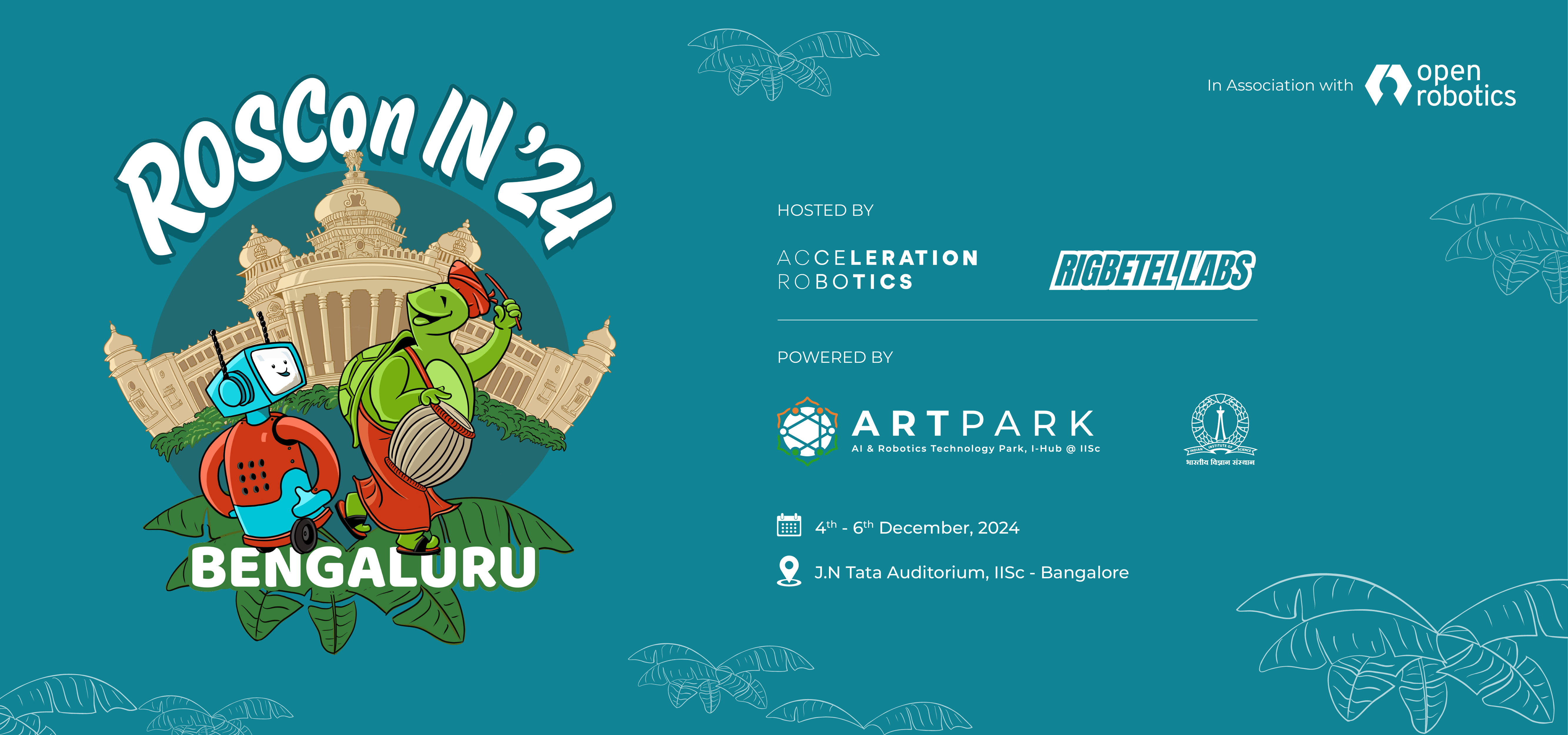
ROSConIN'24 was hosted by ARTPARK at IISc, with support from Open Robotics and multiple industry partners. The crowd had students, researchers, startup teams, and experienced engineers, so discussions were practical and not limited to one level.
Day 0: workshops
There were three workshop tracks:
- Next-gen robotics with NVIDIA Isaac, GenAI, and ROS
- Zenoh as a ROS 2 middleware layer
- ROS 2 controls, navigation, and advanced communication
I attended the third one. It was hands-on and directly relevant to real robot stack integration.
Day 1 highlights
- Keynotes from Geoffrey Biggs and Yadunund Vijay on the state of open robotics
- Session by NVIDIA on current robotics development workflows
- Talks covering RoboGPT, ROS 2 industrial use, and automotive/retail deployment stories
- A strong panel on product-market fit in robotics
The strongest part of Day 1 was seeing the gap between demos and deployable systems discussed openly.
Day 2 highlights
- Angelo Corsaro’s keynote on Zenoh and ROS 2 communication architecture
- Technical sessions on robotics application stacks and simulation-driven methods
- Closing discussion on where the ROS ecosystem is heading in India and globally
Day 2 felt more systems-heavy, especially around communication reliability and architecture choices.
What I took away
- Middleware decisions affect system behavior more than beginners expect
- Tooling maturity matters as much as algorithm quality
- Good robotics engineering is integration discipline, not isolated model performance
- Clear documentation is still a weak point across many teams
That last point is one reason I started documenting my own work more seriously through this blog.
Startups and booths
I also spent time at booths and talked to smaller teams. One that stood out was Vicharak:
- Vaaman: FPGA-based board aimed at AI/ML workloads
- Axon: single-board edge computer for compact high-performance tasks
If you are into edge compute or embedded hardware, check them out: vicharak.in
GNOME Asia Summit (kept this in)
The day after ROSCon, I attended GNOME Asia Summit in Bangalore. It gave a different but complementary view of open source: desktop/Linux communities, contributor workflows, and long-term maintenance culture.
Seeing ROS and GNOME events back-to-back was useful. One was robotics-heavy, the other broader open-source ecosystem thinking. Together, they reinforced the same lesson: community health and documentation quality decide whether technical work scales.
Closing
ROSConIN'24 gave me better technical direction, better context for the ecosystem, and motivation to build in public. Also, out of everyone there, I was the only one who got a handwritten name on my ID card instead of a printed one, unexpectedly memorable.