PD-aware Machine Learning: Congestion, DRC, IR-Drop and Net Delay Prediction


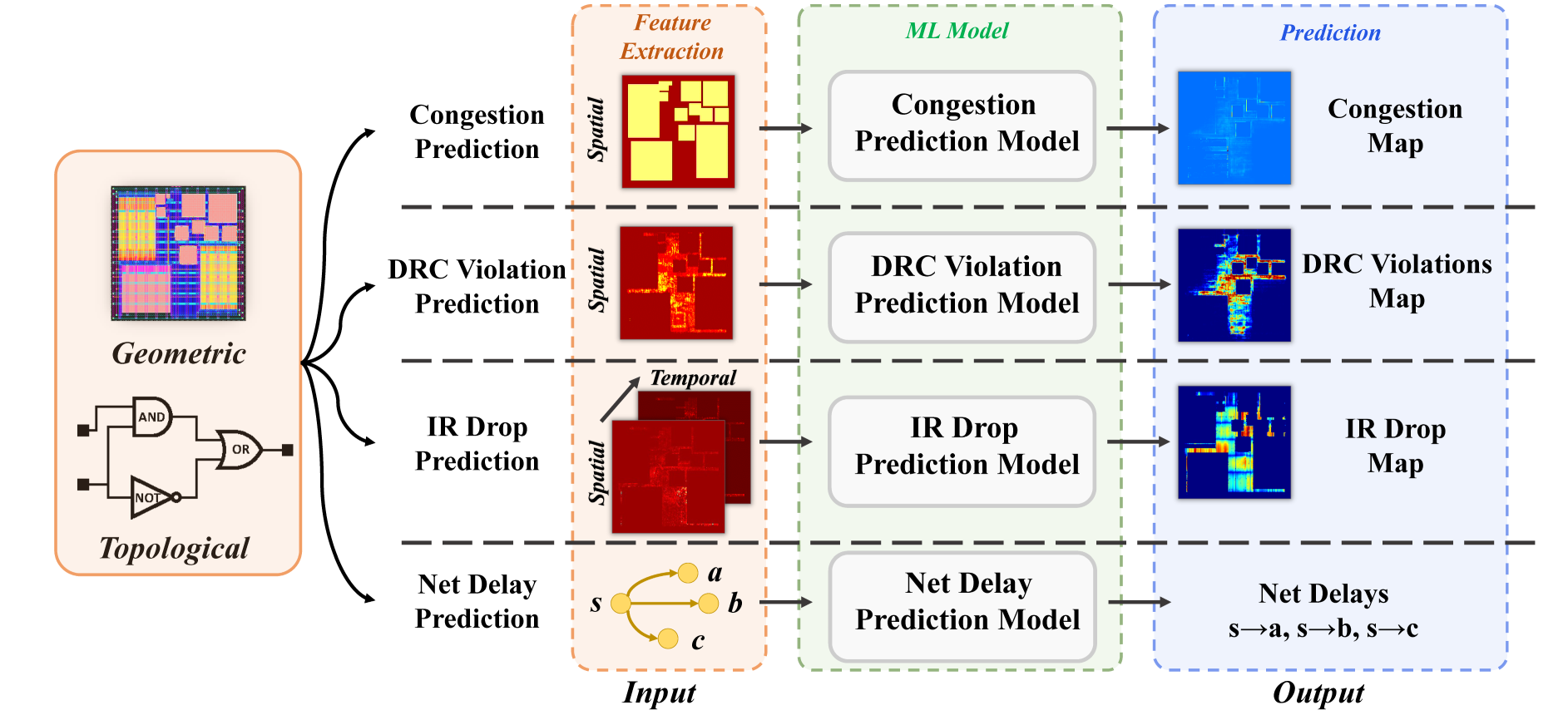
Machine learning in physical design (PD) is not about replacing routing or timing engines. It is about predicting expensive post-route outcomes earlier in the flow.
Inside PD, the questions are:
- Will this placement cause routing congestion?
- Where will DRC violations cluster?
- Which regions will suffer IR drop?
- What will be the net delay before detailed routing?
All of these are spatial or graph-structured problems. That is why most modern approaches convert PD data into:
- Image-like tensors (grid-based Gcells)
- Graph representations (nets and pins)
This post explains:
- What to train for each PD task
- Why each feature exists
- How features are constructed
- What model architecture to use
- How to wire the full training code
No metrics. No benchmarking. Only feature reasoning and implementation.
Congestion Prediction in PD
Congestion is routing demand exceeding routing resources during global routing.
In PD terms:
\[ Congestion = \frac{Routing\ Demand}{Routing\ Capacity} \]
If overflow > 0 → hotspot.
We want to predict congestion at placement stage before routing.
This becomes an image-to-image regression problem.
Input: feature maps over layout grid Output: horizontal + vertical overflow maps
Features Used for Congestion
Three features are sufficient and meaningful:
macro_region
This is a binary or density map indicating macro block locations.
Why it matters:
- Macros block routing tracks.
- They create routing detours.
- Pin access around macros is restricted.
- High macro density increases congestion probability.
Without macro_region, the model cannot learn structural routing barriers.
RUDY (Rectangular Uniform Wire Density)
RUDY estimates routing demand based on net bounding boxes.
Concept:
For each net:
\[ RUDY = \frac{Net\ Degree}{Bounding\ Box\ Area} \]
High RUDY means many nets compressed into small region.
Why it matters:
- Approximates routing demand before routing.
- Encodes net topology implicitly.
- Strong indicator of congestion clusters.
RUDY_pin
Similar to RUDY but weighted by pin density.
Why it matters:
- Regions with high pin concentration require more vias and routing tracks.
- Pin access complexity drives congestion.
- Captures cell-level granularity.
Model Architecture (FCN Encoder–Decoder)
We treat layout as an image.
Encoder extracts spatial patterns. Decoder reconstructs congestion map.
Full model:
import torch
import torch.nn as nn

class conv(nn.Module):
    def __init__(self, dim_in, dim_out):
        super().__init__()
        self.main = nn.Sequential(
            nn.Conv2d(dim_in, dim_out, 3, 1, 1),
            nn.InstanceNorm2d(dim_out, affine=True),
            nn.LeakyReLU(0.2, inplace=True),
            nn.Conv2d(dim_out, dim_out, 3, 1, 1),
            nn.InstanceNorm2d(dim_out, affine=True),
            nn.LeakyReLU(0.2, inplace=True),
        )
    def forward(self, x):
        return self.main(x)

class Encoder(nn.Module):
    def __init__(self, in_dim):
        super().__init__()
        self.c1 = conv(in_dim, 32)
        self.pool1 = nn.MaxPool2d(2)
        self.c2 = conv(32, 64)
        self.pool2 = nn.MaxPool2d(2)
        self.c3 = nn.Conv2d(64, 32, 3, 1, 1)

    def forward(self, x):
        h1 = self.c1(x)
        h2 = self.pool1(h1)
        h3 = self.c2(h2)
        h4 = self.pool2(h3)
        h5 = torch.tanh(self.c3(h4))
        return h5, h2

class Decoder(nn.Module):
    def __init__(self):
        super().__init__()
        self.up1 = nn.ConvTranspose2d(32, 16, 4, 2, 1)
        self.c1 = conv(16, 16)
        self.up2 = nn.ConvTranspose2d(16+64, 4, 4, 2, 1)
        self.out = nn.Conv2d(4, 2, 3, 1, 1)

    def forward(self, x):
        feat, skip = x
        x = self.up1(feat)
        x = self.c1(x)
        x = self.up2(torch.cat([x, skip], dim=1))
        return torch.sigmoid(self.out(x))

class GPDL(nn.Module):
    def __init__(self):
        super().__init__()
        self.encoder = Encoder(3)
        self.decoder = Decoder()

    def forward(self, x):
        return self.decoder(self.encoder(x))
Training:
model = GPDL().cuda()
optimizer = torch.optim.Adam(model.parameters(), lr=1e-4)

for feature, label in loader:
    feature = feature.cuda()
    label = label.cuda()
    pred = model(feature)
    loss = nn.MSELoss()(pred, label)
    optimizer.zero_grad()
    loss.backward()
    optimizer.step()
Label:
congestion_GR_horizontal_overflow
congestion_GR_vertical_overflow
DRC Violation Prediction in PD
DRC violations appear after detailed routing.
Congestion is coarse. DRC violations are technology-aware.
Advanced nodes introduce:
- Spacing violations
- Via enclosure violations
- Min-width violations
Predicting DRC directly avoids routing iteration loops.
Features Used for DRC
Nine features:
macro_region
Same reasoning as congestion.
cell_density
Density of standard cells per tile.
Why it matters:
- High density → narrow routing channels.
- Increased via stacking.
- High probability of spacing violations.
RUDY_long and RUDY_short
Split nets by span length.
- Long nets → global routing stress.
- Short nets → local routing congestion.
Separating them allows model to learn different routing behavior.
RUDY_pin_long
Pin density for long nets.
Important because:
- Long nets crossing macro edges create DRC hotspots.
- Pin clusters around long nets worsen detours.
congestion_eGR_horizontal_overflow
congestion_eGR_vertical_overflow
Early global routing estimation.
Provides coarse routability signal.
congestion_GR_horizontal_overflow
congestion_GR_vertical_overflow
Final global routing overflow.
Used as strong signal before detailed routing.
Model identical to congestion model but with 9 input channels:
class RouteNet(nn.Module):
    def __init__(self):
        super().__init__()
        self.encoder = Encoder(9)
        self.decoder = Decoder()

    def forward(self, x):
        return self.decoder(self.encoder(x))
Loss is computed against:
DRC_all
IR Drop Prediction in PD
IR drop is voltage deviation:
\[ V = IR \]
Excessive IR drop:
- Slows cells
- Breaks timing
- Causes functional failure
Unlike congestion and DRC, IR drop is:
- Spatial
- Temporal (vector-dependent)
Features Used for IR Drop
Five power-related features:
power_i
Instantaneous switching power.
Captures peak current bursts.
power_s
Static leakage power.
Important for always-on regions.
power_sca
Scaled switching power under workload.
Encodes average dynamic stress.
power_all
Combined power density.
Used as global stress indicator.
power_t
Temporal power variation across cycles.
This is critical because:
- IR drop depends on simultaneous switching.
- Peak alignment across regions increases drop.
- Must model temporal correlation.
Model: 3D U-Net
Spatial + temporal aggregation.
Full implementation:
class DoubleConv3d(nn.Module):
    def __init__(self, in_channels, out_channels):
        super().__init__()
        self.double_conv = nn.Sequential(
            nn.Conv3d(in_channels, out_channels, 3, padding=(0,1,1)),
            nn.BatchNorm3d(out_channels),
            nn.ReLU(inplace=True),
            nn.Conv3d(out_channels, out_channels, 3, padding=(0,1,1)),
            nn.BatchNorm3d(out_channels),
            nn.ReLU(inplace=True)
        )
    def forward(self, x):
        return self.double_conv(x)

class MAVI(nn.Module):
    def __init__(self):
        super().__init__()
        self.inc = DoubleConv3d(5, 64)
        self.down = nn.MaxPool3d((1,2,2))
        self.conv2 = DoubleConv3d(64,128)
        self.out = nn.Conv2d(128,1,1)

    def forward(self, x):
        x = self.inc(x)
        x = self.down(x)
        x = self.conv2(x)
        x = x.mean(dim=2)
        return self.out(x)
Training same pattern.
Label: ir_drop
Net Delay Prediction in PD
Net delay before routing depends on:
- Pin positions
- Net topology
- Steiner tree structure
This is not image-based.
This is graph-based.
Features Used
pin_positions
Includes:
- x coordinate
- y coordinate
- layer index
- pin type
These encode geometric distance and topology hints.
net_edges
Defines connectivity:
- source → sink
- sink → source (bidirectional message passing)
Graph construction:
import dgl
import torch

g = dgl.heterograph({
    ('node','net_out','node'):(src_nodes, dst_nodes),
    ('node','net_in','node'):(dst_nodes, src_nodes)
})

g.ndata['nf'] = pin_features
g.edges['net_out'].data['net_delay'] = groundtruth_delay
GNN Model
Full architecture:
class NetDelayPrediction(torch.nn.Module):
    def __init__(self):
        super().__init__()
        self.nc1 = NetConv(4, 0, 16)
        self.nc2 = NetConv(16, 0, 16)
        self.nc3 = NetConv(16, 0, 4)

    def forward(self, g):
        nf = g.ndata['nf']
        x, _ = self.nc1(g, nf)
        x, _ = self.nc2(g, x)
        _, net_delays = self.nc3(g, x)
        return net_delays
Training:
model = NetDelayPrediction().cuda()
optimizer = torch.optim.Adam(model.parameters(), lr=5e-4)

pred = model(g)
loss = torch.nn.functional.mse_loss(
    pred, g.edges['net_out'].data['net_delays_log']
)

loss.backward()
optimizer.step()
PD Perspective
Congestion → spatial resource imbalance DRC → technology constraint violations IR Drop → power integrity failure Net Delay → timing estimation before routing
Each task requires:
- Proper feature engineering
- Physically meaningful inputs
- Architecture aligned with data structure (grid vs graph)
Do not blindly add features.
Each feature must encode:
- Geometric obstruction
- Electrical stress
- Routing demand
- Temporal correlation
- Connectivity structure
Machine learning in PD works only when features respect physical laws.
Reference
https://circuitnet.github.io/tutorial/experiment_tutorial.html