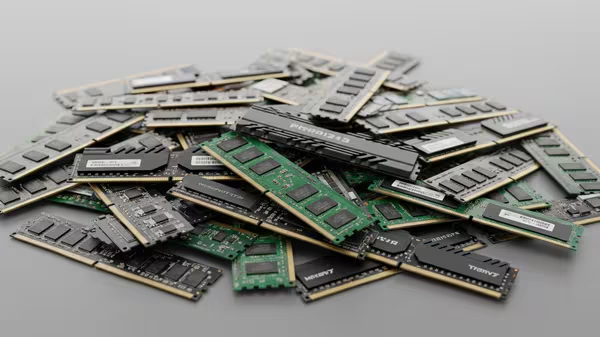
Why Are RAM Prices Skyrocketing? A Technical Perspective on the 2025 Memory Surge


Earlier this year, reports surfaced that Samsung was facing internal constraints on advanced memory allocation — particularly around high-bandwidth memory (HBM) and leading-edge DRAM nodes. Around the same time, competitors like SK Hynix were effectively sold out of HBM capacity for AI accelerators.
Public statements were carefully worded, but the implication was clear:
Advanced memory supply is being absorbed faster than it can be produced.
Now we are in a situation where:
- DDR4 and DDR5 prices are rising again
- Laptop and PC upgrades cost more
- Server memory lead times are increasing
- GPU pricing remains elevated
The question is not “is there a supply chain issue?”
The real question is:
Why is memory suddenly expensive again — and why does AI have anything to do with your desktop RAM?
The Real Driver: AI Infrastructure Is Consuming Memory at Scale
Modern AI accelerators, particularly those used in data centers, require enormous amounts of memory bandwidth.
For example, GPUs designed for large language models depend heavily on HBM (High Bandwidth Memory). Companies like NVIDIA deploy accelerators that require multiple stacks of HBM3 or HBM3e per device.
Each advanced AI GPU can require:
- 80GB–192GB of HBM
- Multi-terabyte/s memory bandwidth
- Complex 2.5D packaging (TSMC CoWoS-style interposers)
HBM production is far more complex than traditional DDR memory:
- Through-silicon vias (TSVs)
- 3D die stacking
- Precision alignment
- Yield-sensitive bonding
When AI demand exploded, foundry and memory vendors prioritized HBM because:
- It has higher margins
- It is strategically critical
- It is contractually locked by hyperscalers
That production capacity did not come from nowhere.
It came from somewhere.
Memory Production Is Not Infinitely Elastic
Memory fabs are capital-intensive and node-specific.
A DRAM fab optimized for DDR4 cannot instantly pivot to HBM3.
Moreover, when manufacturers allocate more wafer starts to HBM:
- Less capacity remains for DDR5
- Even less remains for legacy DDR4
- LPDDR supply tightens
Memory production decisions happen quarters in advance.
AI demand happened in months.
The imbalance shows up as price spikes.
Why This Impacts Consumer RAM
You might assume:
HBM is server-only. Why does it affect my desktop DDR5?
Because the same companies produce:
- DDR4
- DDR5
- LPDDR
- HBM
When advanced nodes shift toward HBM:
- DDR5 wafer allocation shrinks
- Price floors increase
- Inventory buffers tighten
Add to this:
- Vendors reducing production during previous downturn
- Reduced overcapacity after 2022 oversupply
- Conservative expansion planning
The result is simple:
Lower surplus + sudden demand surge = price correction upward.
We Are No Longer in the Cheap-Memory Era
Between 2016–2022, memory pricing followed boom-bust cycles.
But the AI wave changed the demand profile:
- AI training clusters consume memory continuously
- Cloud providers refresh hardware aggressively
- Hyperscalers lock multi-year supply contracts
This creates structural demand, not speculative demand.
Memory is no longer primarily driven by:
- PC sales
- Smartphone cycles
It is driven by:
- AI model scaling
- Inference deployment
- Data center expansion
And that changes pricing dynamics.
What This Means for Us
PC Builders
- DDR5 upgrades cost more
- 32GB kits are no longer “cheap”
- Waiting may not yield dramatic price drops
Embedded Engineers
- BOM cost increases
- LPDDR sourcing becomes harder
- Long-term availability planning becomes critical
Startups
- Prototyping server clusters is more expensive
- On-prem inference hardware costs rise
- Budget forecasting becomes unpredictable
GPU Buyers
Even though GPUs are compute devices, memory cost is a major component.
HBM pricing influences:
- Data center GPU MSRP
- AI accelerator pricing
- Secondary GPU market stability
Is Samsung “Out of Memory”?
There were reports implying Samsung struggled to meet advanced HBM validation requirements earlier this year.
That does not mean they ran out of memory entirely.
It likely means:
- Yield challenges on advanced stacks
- Delayed qualification cycles
- Capacity allocation constraints
In semiconductor manufacturing, small yield drops create large effective supply reductions.
When yields dip by even 5–10% in high-end memory:
- Effective output shrinks dramatically
- Spot pricing reacts immediately
This Is a Structural Shift, Not a Temporary Spike
Unlike previous RAM price surges driven by:
- Crypto mining
- Smartphone booms
- Temporary shortages
This surge is linked to compute infrastructure transformation.
AI models are scaling:
- Parameter counts increasing
- Context windows expanding
- Training datasets growing
All of this translates to:
\[ Memory\ Demand \propto Model\ Size \times Parallelism \]
And memory bandwidth demand scales even faster.
What Could Normalize Prices?
Potential stabilizers:
- New fab capacity online
- Yield improvements in HBM3e
- AI demand plateau
- Alternative memory architectures
But none of these are immediate.
Building a new memory fab takes years.
Improving yield takes quarters.
Demand contraction is unlikely in the short term.
The Broader Engineering Implication
We are entering an era where:
- Memory is strategic infrastructure
- Advanced packaging is the bottleneck
- Bandwidth matters more than raw compute
For system architects, this means:
- Memory-aware design is critical
- Data movement dominates energy cost
- Bandwidth optimization becomes competitive advantage
Memory is no longer a passive component.
It is a primary constraint.
Final Perspective
RAM prices are rising because memory is being re-prioritized toward AI infrastructure at scale.
This is not merely “market volatility.”
It reflects:
- A reallocation of fabrication capacity
- Advanced packaging constraints
- Yield sensitivity at bleeding-edge nodes
- Sustained hyperscale demand
The uncomfortable reality is:
We are competing for memory with trillion-parameter models.
And that competition is not temporary.
Until capacity catches up — or demand cools — memory pricing pressure will likely persist.
The era of abundant, cheap DRAM may not return in the same form.