
Why Should You Start Solving Puzzles? #PID1.0


Puzzles look like entertainment, but they are one of the best ways to train structured thinking.
At a technical level, every puzzle is the same core problem: define constraints, explore state space, and choose moves that reduce uncertainty. That is exactly how we debug code, design systems, and optimize hardware.
Why solve puzzles?
Problem decomposition. You learn to break a large problem into smaller solvable parts. A puzzle rarely has one obvious entry point – you look for what you can fix first, and build from there.
Pattern recognition. You start spotting recurring structures and shortcuts. The same configuration shows up in different contexts, and you learn to recognize it before thinking explicitly about why.
Search strategy. You compare brute-force trial with heuristic or algorithmic methods. Most puzzles punish pure trial-and-error. You develop instincts about when to explore and when to commit.
Focus under constraints. You improve decision-making with limited time and incomplete information. That skill does not stay inside the puzzle.
This is why puzzle training transfers well to engineering work – the loop is the same, just the domain changes.
Coding is a puzzle engine
Programming is puzzle solving with formal rules. Bugs are hidden states. Constraints are API contracts, timing requirements, and hardware limits. A good solution is one that is correct, maintainable, and efficient – not just one that passes the test cases you thought to write.
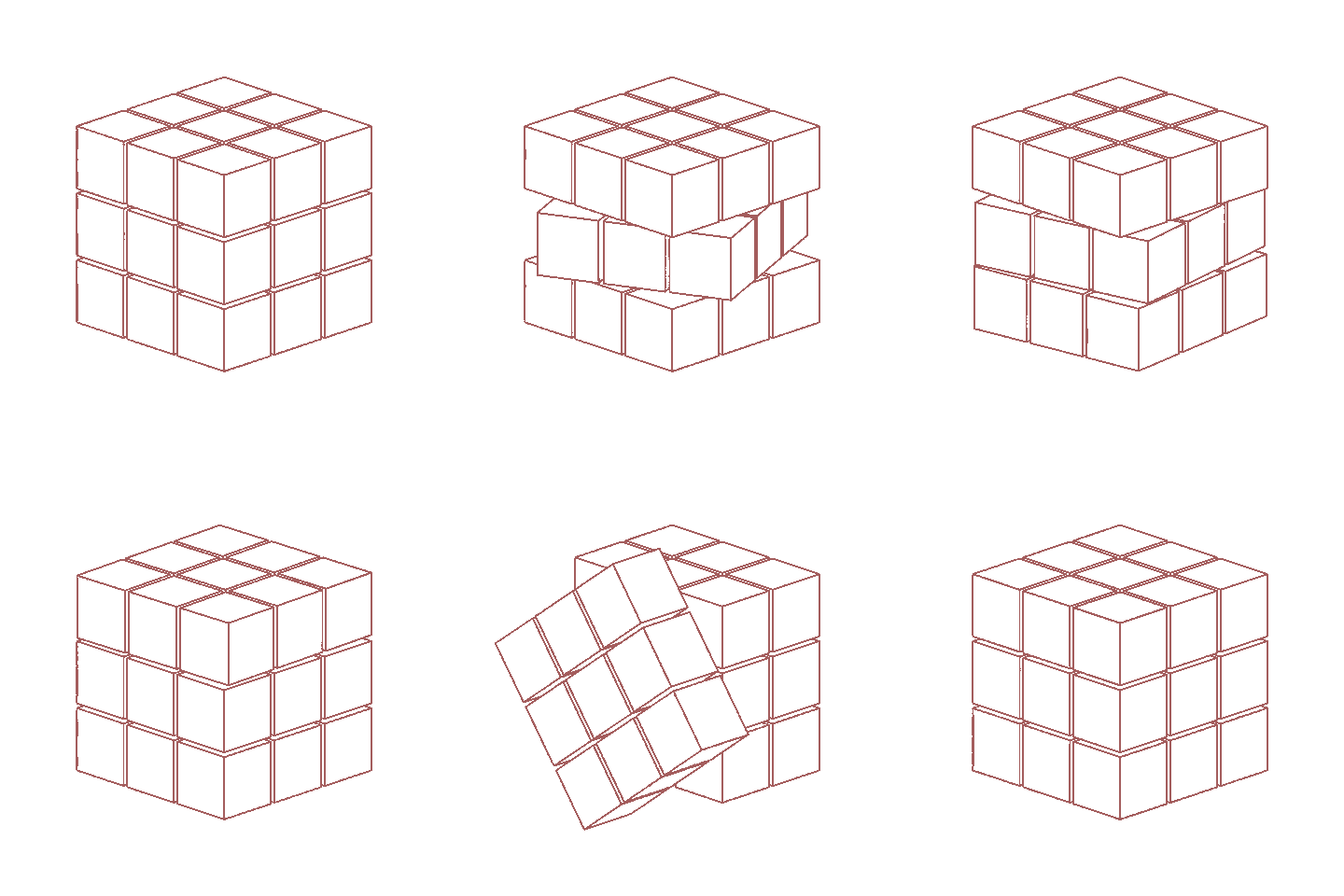
If you enjoy debugging, optimization, or system design, you already enjoy puzzle thinking. The Rubik’s Cube just makes that loop explicit and tactile.
Why Rubik’s Cube is special
Most puzzles reward one type of thinking. The cube is different because it asks for several in sequence.
You start with visual patterns – recognizing which pieces are wrong and where they belong. Then you move to move-sequence memory, learning algorithms that reliably produce a known outcome. Finally, you start reasoning in terms of states, permutations, and what the cube group actually allows. That last step is where it gets interesting.
That progression makes the cube useful for both beginners and technical learners, and it is why this series uses it as the vehicle rather than a simpler puzzle.
About this series
This post starts the PID: Project IN Detail series, specifically the Rubik’s Cube Solver track. The goal is not just to solve the cube – it is to build a solver, understand the algorithms behind it, and eventually implement it in simulation and hardware.
The roadmap is practical:
- Learn the cube’s structure and solving logic (where we are now).
- Understand the mathematics that makes the cube a well-defined problem.
- Translate solving logic into algorithms a computer can execute.
- Build a simulation, then move toward hardware-assisted solving.
I am currently in the simulation phase and will document each step as it actually happened – including the parts that did not work and the decisions I had to revisit.
Closing
If you want better technical intuition, do not just read more. Solve more.
Start with one puzzle type, stay consistent, and track how your reasoning changes over a few weeks. The compounding effect is real, and it shows up in unrelated work faster than you expect.