Thistlethwaite’s algorithm, covered in the previous post, established the foundational idea: partition the cube group G into a chain of nested subgroups …
Kociemba algorithm
two-phase solver
pruning tables
category · 6 posts
Thistlethwaite’s algorithm, covered in the previous post, established the foundational idea: partition the cube group G into a chain of nested subgroups …
The previous post established the mathematical structure of the Rubik’s Cube: a non-abelian group of order 43,252,003,274,489,856,000, where each element …
The previous post described how humans approach the cube through staged reduction: fix one subgroup of pieces, then the next, until nothing remains. That …
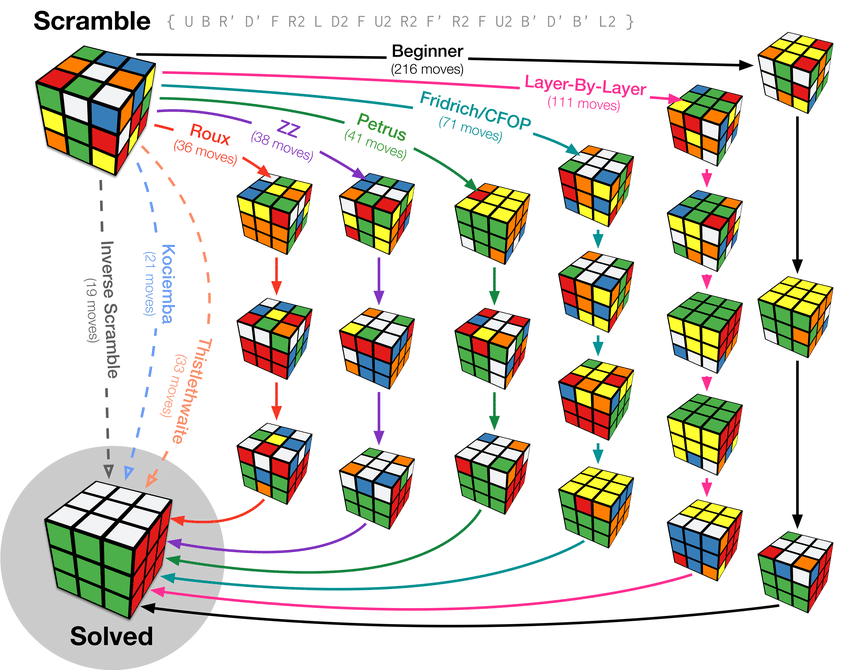
Knowing the mechanics of the cube from the previous post is the foundation. Now the question is how to actually solve it – and more specifically, what …
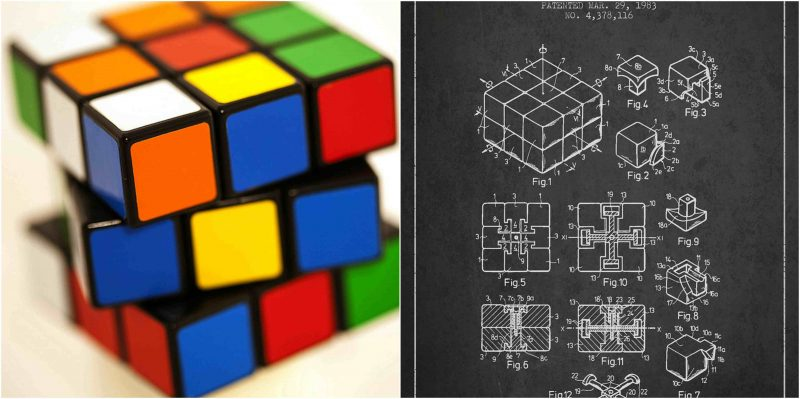
Before you can think about solving the cube algorithmically, you need to know what you are actually working with. The physical structure of the cube is not just …

Puzzles look like entertainment, but they are one of the best ways to train structured thinking. At a technical level, every puzzle is the same core problem: …