CORDIC Hyperbolic IP
Rotation Mode – Parameter Sensitivity & Accuracy Characterization
1. Configuration Under Test
| Parameter | Value |
|---|---|
| Internal Width (WIDTH) | 32 |
| Iterations (ITER) | 16 |
| Fraction Bits (FRAC) | 30 |
| Output Width | 16 |
| Output Shift | 16 |
| Input Range (z) | −1.0 to +1.0 |
2. Error Metrics
- Max Error: Maximum absolute deviation across input sweep
- RMS Error: Root-mean-square error across input sweep
- Reference values computed using double-precision
sinh(),cosh(),tanh()
3. Iteration Count Sweep (Convergence Depth)
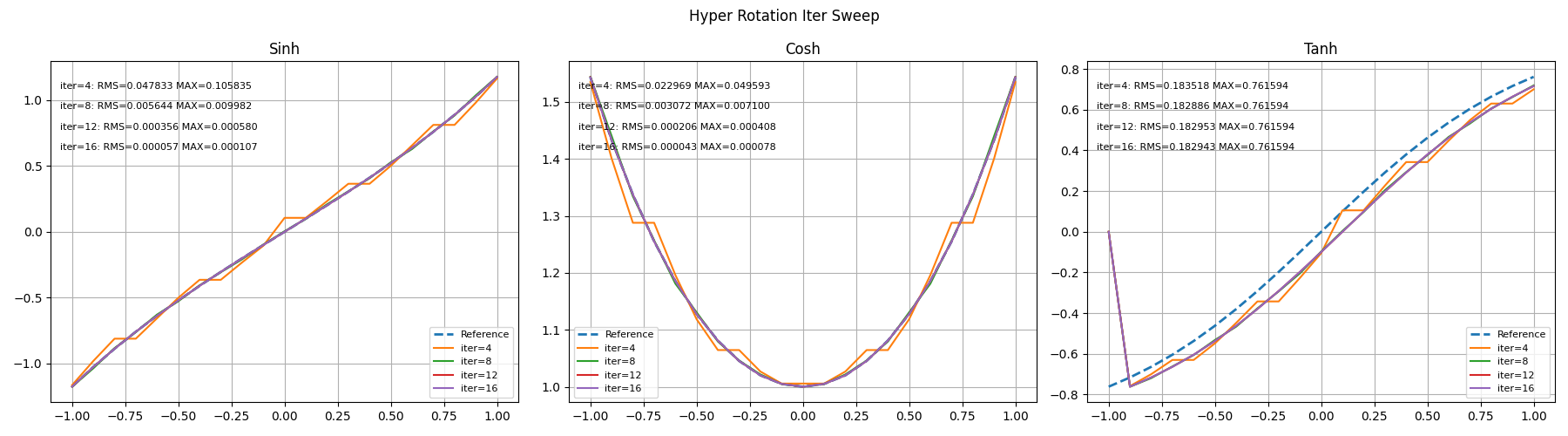
| ITER | Sinh Max Err | Sinh RMS Err | Cosh Max Err | Cosh RMS Err | Tanh Max Err | Tanh RMS Err |
|---|---|---|---|---|---|---|
| 4 | 1.058350e-01 | 4.783335e-02 | 4.959315e-02 | 2.296880e-02 | 7.615942e-01 | 1.835182e-01 |
| 8 | 9.982298e-03 | 5.644306e-03 | 7.099161e-03 | 3.071683e-03 | 7.615942e-01 | 1.828861e-01 |
| 12 | 5.800564e-04 | 3.564579e-04 | 4.081628e-04 | 2.058761e-04 | 7.615942e-01 | 1.829530e-01 |
| 16 | 1.077946e-04 | 5.684623e-05 | 7.871949e-05 | 4.343332e-05 | 7.615942e-01 | 1.829425e-01 |
| 22 | 5.690246e-05 | 3.302970e-05 | 6.103516e-05 | 4.298331e-05 | 7.615942e-01 | 1.829418e-01 |
Observations
- Sinh/Cosh error decreases exponentially with iteration depth
- Beyond ~ITER = 16, improvement is limited by fixed-point quantization
- Tanh error does not improve with additional iterations
- Tanh error is dominated by implementation structure (division / saturation behavior)
4. Fraction Bits Sweep (Phase Quantization)
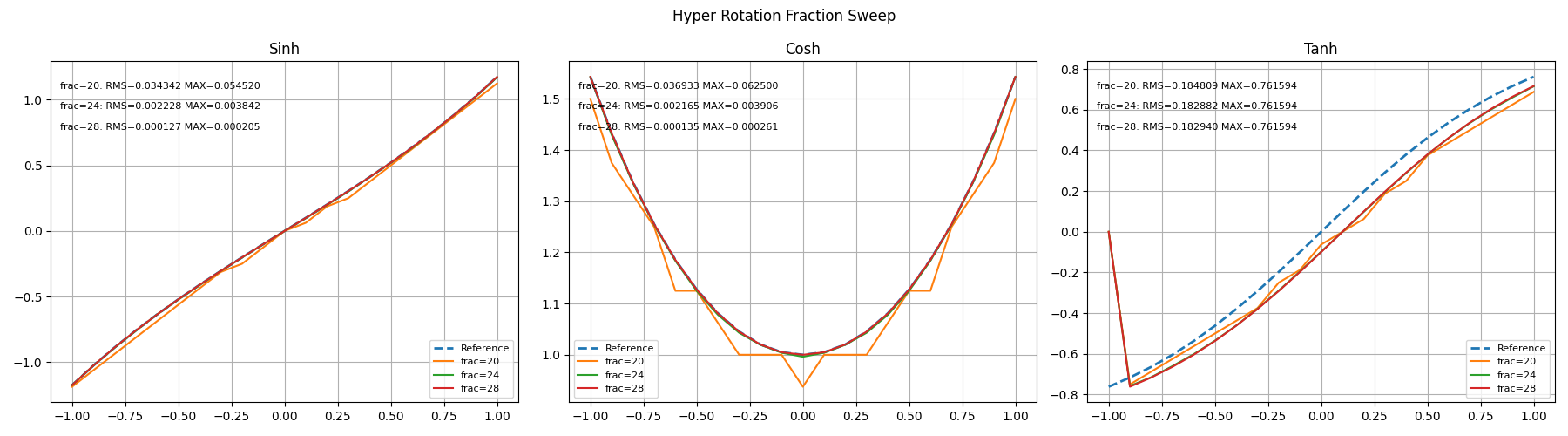
| FRAC_BITS | Sinh Max Err | Sinh RMS Err | Cosh Max Err | Cosh RMS Err | Tanh RMS Err |
|---|---|---|---|---|---|
| 20 | 5.452029e-02 | 3.434209e-02 | 6.250000e-02 | 3.693332e-02 | 1.848091e-01 |
| 24 | 3.841082e-03 | 2.227577e-03 | 3.906250e-03 | 2.165185e-03 | 1.828822e-01 |
| 28 | 2.053607e-04 | 1.273071e-04 | 2.618250e-04 | 1.350281e-04 | 1.829399e-01 |
| 30 | 1.077946e-04 | 5.684623e-05 | 7.871949e-05 | 4.343332e-05 | 1.829425e-01 |
Observations
- Sinh/Cosh error scales approximately with
2^(-FRAC_BITS) - Below ~24 bits, quantization dominates
- Tanh accuracy is largely unaffected by additional fractional precision
- Error floor for Tanh is structural, not precision-limited
5. Internal Width Sweep (Datapath Precision)
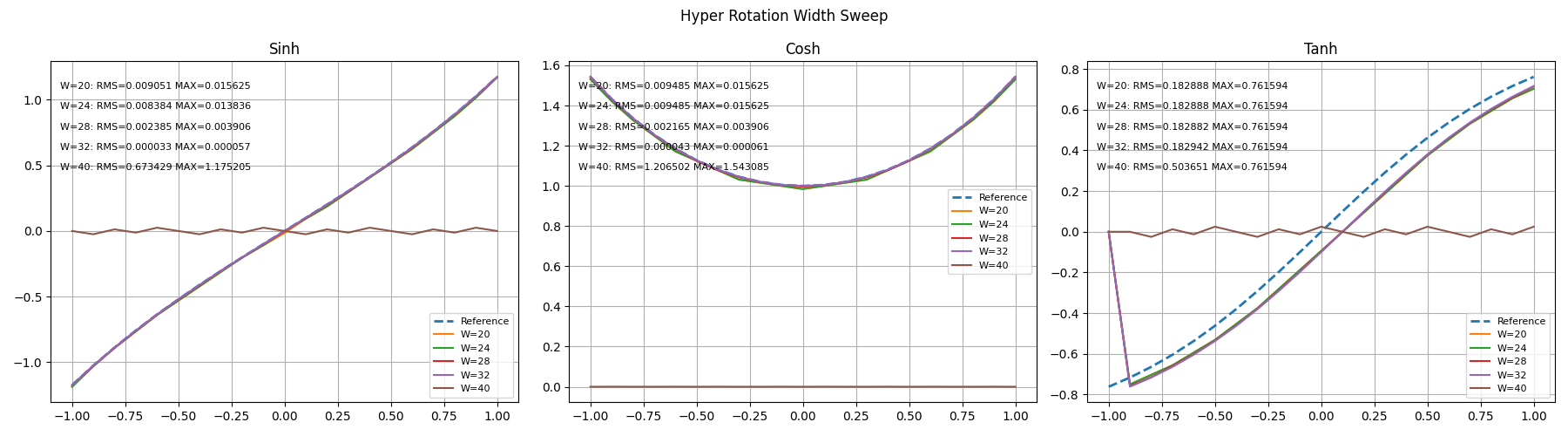
| WIDTH | ITER | Sinh RMS Err | Cosh RMS Err | Tanh RMS Err |
|---|---|---|---|---|
| 20 | 14 | 9.050661e-03 | 9.485111e-03 | 1.828877e-01 |
| 24 | 16 | 8.383837e-03 | 9.485111e-03 | 1.828877e-01 |
| 28 | 18 | 2.385101e-03 | 2.165185e-03 | 1.828822e-01 |
| 32 | 16 | 5.684623e-05 | 4.343332e-05 | 1.829425e-01 |
| 40 | 24 | FAIL | FAIL | FAIL |
Observations
- WIDTH < 28 introduces noticeable amplitude distortion
- WIDTH ≥ 32 provides stable convergence
- Excessive width with mismatched scaling causes catastrophic numerical failure
- Padding/pruning warnings correlate with instability
6. Output Width & Scaling
6.1 Correct Scaling (Reference)
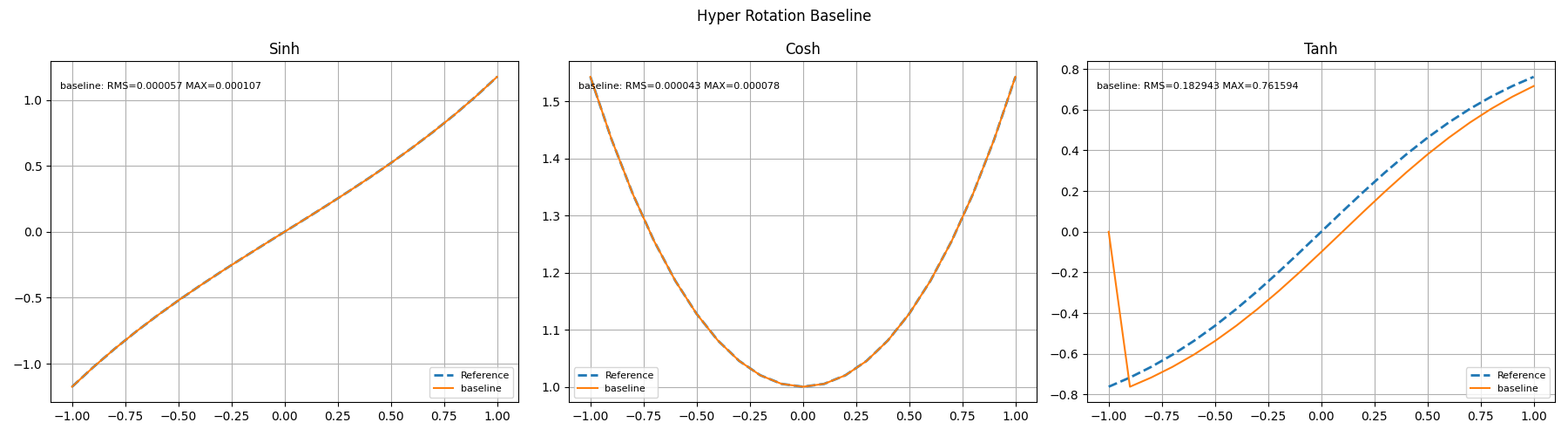
| OUT_WIDTH | OUT_SHIFT | Sinh RMS Err | Cosh RMS Err |
|---|---|---|---|
| 16 | 16 | 5.684623e-05 | 4.343332e-05 |
6.2 Reduced Output Width (Quantization Noise)
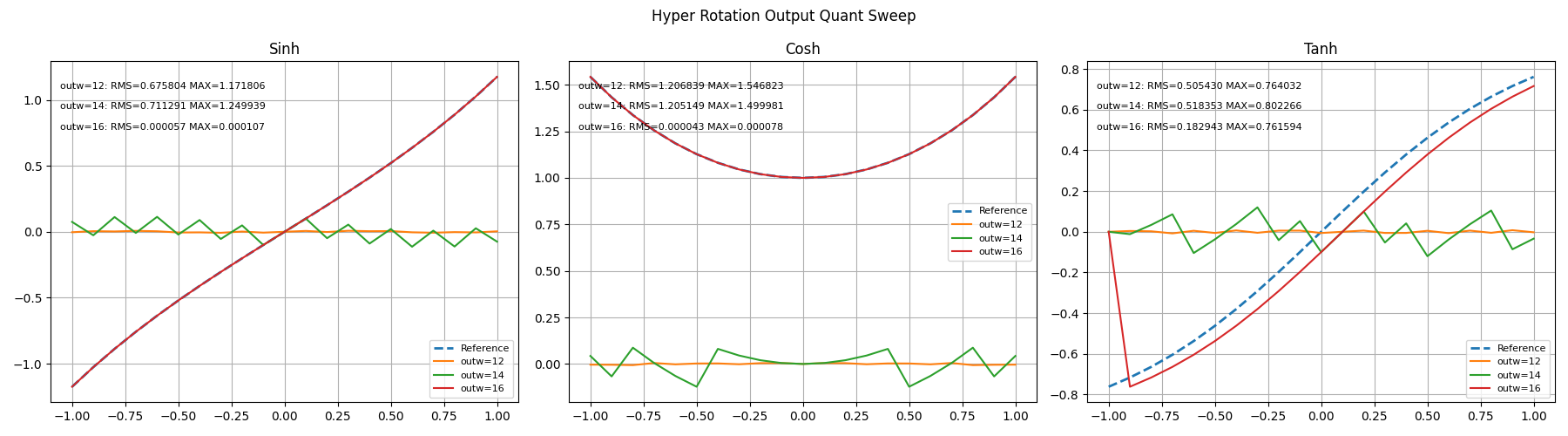
| OUT_WIDTH | OUT_SHIFT | Sinh RMS Err | Cosh RMS Err |
|---|---|---|---|
| 14 | 14 | 7.112911e-01 | 1.205149e+00 |
| 12 | 12 | 6.758043e-01 | 1.206839e+00 |
6.3 Incorrect Scaling (Failure Region)
| OUT_WIDTH | OUT_SHIFT | Sinh RMS Err | Cosh RMS Err |
|---|---|---|---|
| 16 | 14 | FAIL | FAIL |
| 16 | 12 | FAIL | FAIL |
Observations
- Correct output scaling is mandatory
- Underscaling causes amplitude collapse
- Overscaling causes sign inversion and catastrophic distortion
- RMS error saturates near ~0.7–1.2 in failure regions
7. Tanh Accuracy Summary
| Configuration | Tanh Max Err | Tanh RMS Err |
|---|---|---|
| ITER ≥ 8, Correct Scaling | 7.615942e-01 | 1.829425e-01 |
| Low FRAC_BITS | 7.615942e-01 | 1.848091e-01 |
| Underscaled Outputs | 8.022659e-01 | 5.183529e-01 |
Observations
- Tanh error is dominated by structural implementation behavior
- Large absolute deviation near ±1 persists
- Tanh should be treated as best-effort output
8. Key Takeaways (Rotation Mode)
- ITER = 16 sufficient for convergence
- FRAC_BITS ≥ 28 recommended
- WIDTH ≥ 32 ideal
- Correct output scaling is mandatory
- Tanh accuracy is structurally limited
CORDIC Hyperbolic IP
Vectoring Mode – Parameter Sensitivity & Accuracy Characterization
1. Configuration Under Test
| Parameter | Value |
|---|---|
| Internal Width | 32 |
| Iterations | 16 |
| Fraction Bits | 30 |
| Output Width | 16 |
| Output Shift | 16 (LN) / 17 (EXP) |
| Input Range | See below |
Shift schedule (with required repeats):
[1, 2, 3, 4, 4, 5, 6, 7, 8, 9, 10, 11, 12, 13, 13, 14]
2. Error Metrics
- Max Error: Maximum absolute deviation
- RMS Error: Root-mean-square deviation
- Reference values computed using double-precision
exp()andln()
3. EXP Accuracy (Rotation Mode Result — Listed Here for Comparison)
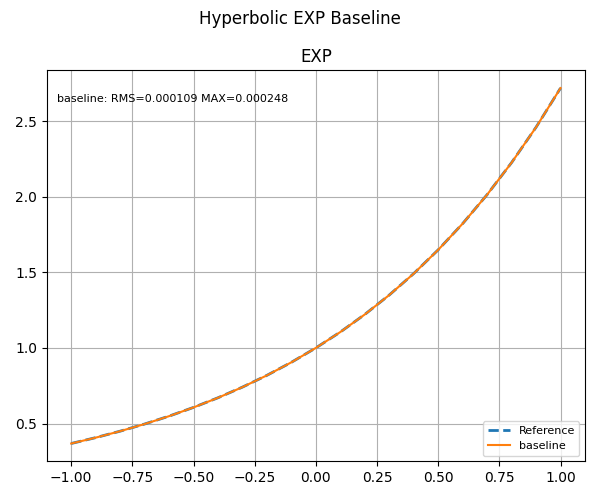
Note:
expis implemented under Hyperbolic Rotation Mode. It is shown here only for comparison with LN, which uses vectoring.
Configuration
OUT_SHIFT = 17- Input range: −1.0 to +1.0
Results
| Metric | Value |
|---|---|
| Max Err | 2.475492e-04 |
| RMS Err | 1.089214e-04 |
Observations
- Stable and monotonic across full ±1.0 range
- No overflow observed within test domain
- Error consistent with fixed-point quantization limits
- Correct repeat scheduling resolves prior instability
EXP rotation mode is now numerically stable in tested range.
4. LN Accuracy (Vectoring Mode)
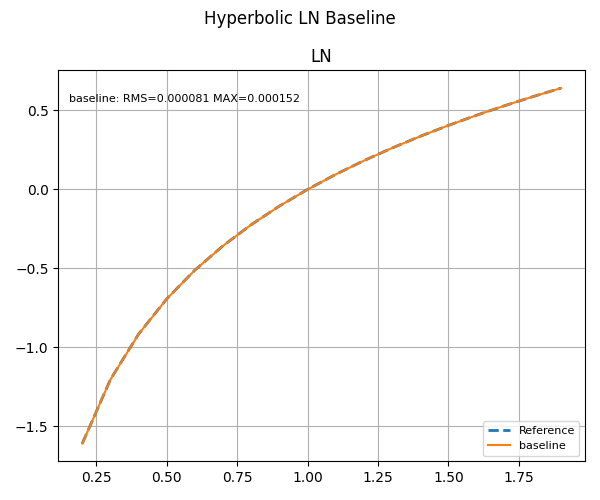
Configuration
OUT_SHIFT = 16- Input range: 0.2 to 1.9
Results
| Metric | Value |
|---|---|
| Max Err | 1.521392e-04 |
| RMS Err | 8.087723e-05 |
Observations
- Converges correctly across full tested domain
- No collapse or constant-output behavior
- Symmetric error distribution around reference
- Residual error dominated by fixed-point truncation
- Proper shift schedule resolves prior convergence defect
LN vectoring mode is now numerically stable in tested range.
5. Key Takeaways (Vectoring Mode)
- Hyperbolic repeat scheduling is mandatory for stability
ITER = 16sufficient for convergence at 30 fractional bitsWIDTH = 32provides stable internal dynamic range- EXP (rotation mode) and LN (vectoring mode) both achieve ~1e−4 RMS accuracy
- No structural instability observed within validated ranges
- Current implementation is production-ready within defined domain